

The Five Principles of Heaven's Economy ~ A Biblical Framework for Purpose, Stewardship, and Aligned Living
A working guide to the principles that organize the Heaven's Economy Blueprint™, the framework at the heart of ARIYAH CODES®, for spirit-led entrepreneurs, builders, living into their purpose.


What Are the Five Principles of Heaven’s Economy?
Heaven’s Economy is a biblical framework for discovering your purpose, stewarding your gifts, building meaningful work, and living according to God’s design. At the heart of the Heaven’s Economy Blueprint™ are five foundational principles: Stewardship, Circulation, Alignment, Syntropy, and Rest.
Together, these principles help answer three of life’s most important questions:
Why am I here?
What am I called to build?
How do I steward it faithfully?
For spirit-led entrepreneurs, business owners, creatives, leaders, and anyone seeking biblical purpose, Heaven’s Economy offers an alternative to burnout, hustle culture, scarcity thinking, and performance-driven success.
Success in Heaven’s Economy is measured through faithfulness, stewardship, fruitfulness, obedience, character, and legacy. The goal is not simply to build more. The goal is to build what God designed you to build and steward it well.
The Five Heaven’s Economy Principles at a Glance
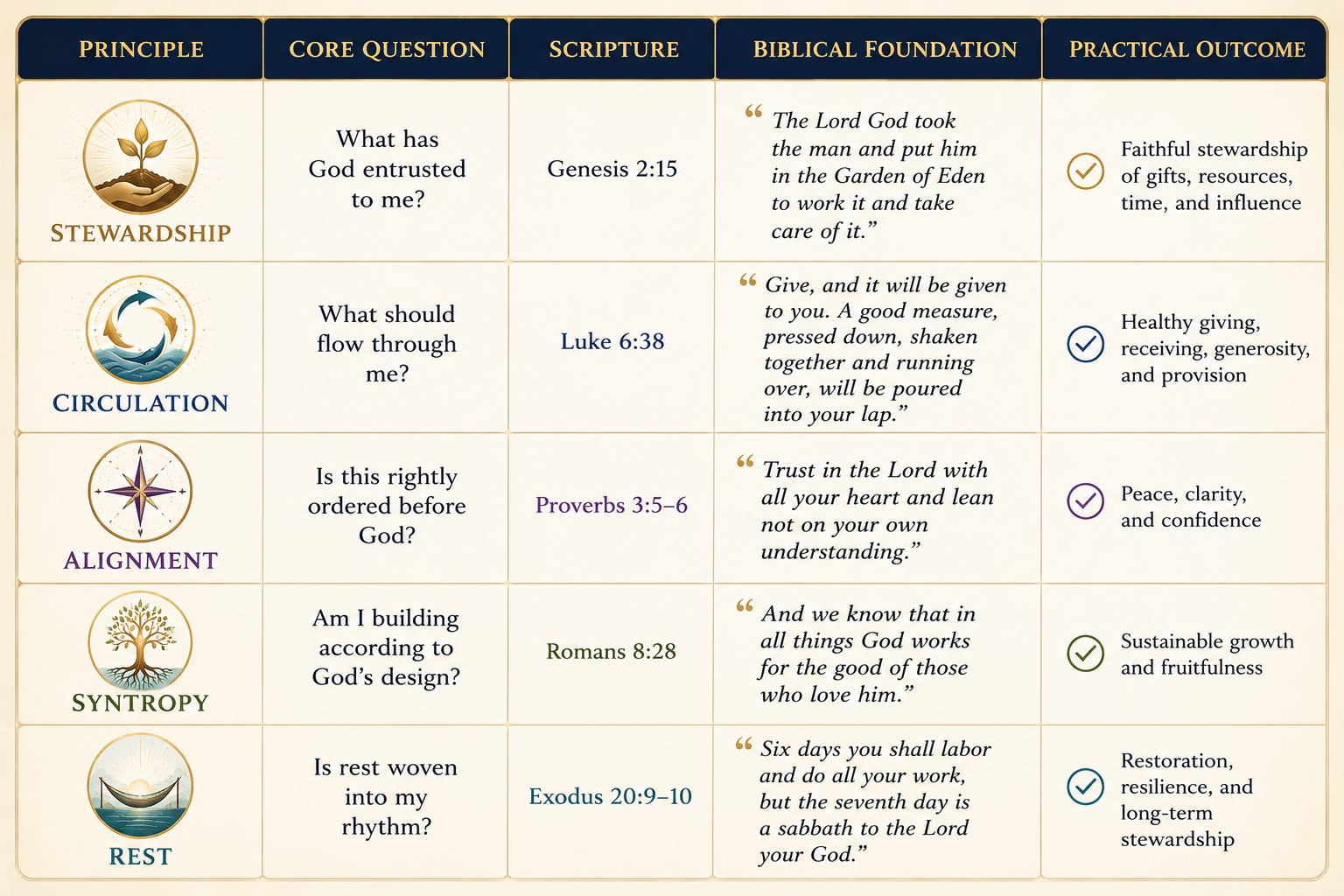
What follows walks through each principle in depth, with scripture, application, and the question each one helps you answer about your own life and work.
Why These Five Principles
Most economic frameworks teach you how to extract more from a world of scarcity. Scripture teaches a different order. Provision is given. Work is the tending of what is given. Increase follows from faithful stewardship rather than from striving.
These five principles describe one pattern, the way God designed life and work to flourish.
I did not arrive at these principles through theory alone. They emerged through years of building businesses, navigating seasons of expansion and contraction, recovering from burnout, stewarding opportunities, and learning what Scripture teaches about fruitfulness. Over time, I began to see the same pattern repeating itself. Wherever there was sustainable growth, these principles were present. Wherever there was exhaustion, scarcity, or striving, one or more had been neglected. What follows is the framework that emerged from that watching.
Principle One: Stewardship
Stewardship is the recognition that you carry and tend what God entrusts to you. You are the keeper, not the owner. This is the foundation of biblical stewardship and the starting point of Christian entrepreneurship rooted in scripture.
Scripture establishes this pattern in the opening pages of Genesis.
“And the Lord God took the man, and put him into the garden of Eden to dress it and to keep it.” (Genesis 2:15, KJV)
The garden was already provided. The work was the tending of what had already been given. Provision came first. Labor was the care of provision, the keeping of it in good order.
This single shift changes how you hold every resource. Money, time, gifts, influence, relationships, work itself. The steward cultivates what has been entrusted. The owner defends what he believes he earned. One posture produces peace and increase. The other produces fear and depletion.
The question stewardship asks: What has God placed in my hand to tend, and am I tending it faithfully?
Practical application: Take an honest inventory of what you have been entrusted with. Your time, your skills, your finances, your relationships, your platform. For each, ask whether you are cultivating it like a garden or guarding it like a possession. The answer often reveals where peace has gone missing.
Principle Two: Circulation
What comes to you is meant to keep moving. Provision stays alive in the flow of giving and receiving.
This is the pattern of every healthy system. Breath circulates. Water circulates. Blood circulates. A garden that stops receiving water dies. A body that stops moving fails. Heaven’s Economy reads provision the same way. What you hoard stagnates. What you circulate multiplies.
“Give, and it shall be given unto you; good measure, pressed down, and shaken together, and running over, shall men give into your bosom. For with the same measure that ye mete withal it shall be measured to you again.” (Luke 6:38, KJV)
Circulation is participation in the living order of provision. You give because the keeping itself requires giving. You receive because the giving itself requires receiving. Both are part of the same motion.
The question circulation asks: What is moving through me, and am I letting it move freely?
Practical application: Look at where you have stopped giving and ask why. Often the answer is fear of scarcity. Then look at where you have stopped receiving (help, rest, support, provision) and ask why there. Often the answer is the long habit of overgiving. Restoring circulation means restoring both directions.
Principle Three: Alignment
Alignment is the inward recognition of what is rightly ordered before God. When a life, a business, or an offering moves in alignment, it carries a settled peace the soul recognizes before the mind explains it.
“Trust in the Lord with all thine heart; and lean not unto thine own understanding. In all thy ways acknowledge him, and he shall direct thy paths.” (Proverbs 3:5-6, KJV)
Alignment is the currency of Heaven’s Economy. Worth here is measured by coherence between calling and action, between gift and assignment, between the inner life and the outer one. This is what purpose-driven business actually requires: not louder marketing, but deeper alignment.
Misalignment is often what burnout actually is. A misaligned body causes back pain. A business in misalignment produces overwork and shrinking yield. A life in misalignment produces the strange exhaustion of being busy without being fruitful. Alignment is what restoration moves toward.
The question alignment asks: Is this in right order before God, and does it carry the peace that confirms it?
Practical application: Take one current effort, a project, role, relationship, or financial pattern, and test it against alignment. Does it produce peace or chronic strain? Does it draw out your gifts or work against them? Does it accord with what God has placed before you, or with what others have expected of you? Misalignment is rarely fixed by working harder. It is fixed by returning to right order.
Principle Four: Syntropy
Syntropy is the movement toward divine order, harmony, and living increase. It is the opposite of entropy, the drift toward disorder that all systems experience without active care.
A garden in good order yields more than a garden worked harder and tended worse. A business built on right structure produces fruit a business built on striving cannot match. Increase in Heaven’s Economy comes through alignment, faithful structure, wise stewardship, and sustainable rhythms.
“And we know that all things work together for good to them that love God, to them who are called according to his purpose.” (Romans 8:28, KJV)
When you build according to God’s design, the design itself produces increase. You are not generating the increase by sheer effort. You are participating in an order that is already producing it. This is what biblical success actually looks like: fruit appearing because the conditions for fruit have been honored.
The question syntropy asks: Am I building in a way that compounds with God’s design, or in a way that fights against it?
Practical application: Examine your work for structures that produce fruit naturally versus structures that require constant force to keep alive. The first are aligned with syntropy. The second usually need to be rebuilt or released.
Principle Five: Rest
Rest is part of the work, not its absence. Heaven’s Economy includes the Sabbath at the foundation of its order, not as recovery from depletion but as participation in divine rhythm.
“Six days shalt thou labour, and do all thy work: But the seventh day is the sabbath of the Lord thy God: in it thou shalt not do any work.” (Exodus 20:9-10, KJV)
Most modern frameworks treat rest as a reward for productivity. Scripture treats rest as a productive force in itself. The body that rests builds. The mind that rests sees clearly. The nervous system that rests can hold the frequency of provision long enough for it to take root.
This is why nervous system restoration belongs to an economy. A body locked in chronic survival mode cannot steward well, cannot circulate freely, cannot perceive alignment, cannot trust syntropy. The interior life is the ground on which the economic life rests.
The question rest asks: Is rest woven into my life as a rhythm, or am I treating it as the leftover space after striving?
Practical application: Look at your week and identify whether rest has a real place in it or is something you take when exhaustion forces it. The shift from one to the other is often the most economically productive change a person can make.
How the Principles Work Together
These five principles are not a checklist. They describe one integrated pattern.
When all five are in place, a life and a business become fruitful in the biblical sense. Fruit appears because the conditions for fruit have been honored. When one is missing, the others strain to compensate, and over time the whole begins to feel like effort rather than flow.
From Searching to Building: What This Framework Makes Possible
When the five principles take hold in a life, the change shows up in concrete ways.
The reader who arrived asking “Why am I here?” begins to recognize the design they were already carrying. Purpose stops being something to chase and becomes something to steward. The fog clears.
The builder who was striving begins to build differently. Effort becomes effort in the right direction, the kind that compounds with God’s order rather than fighting against it. Work begins to produce fruit, the biblical measure of success, faithfulness yielding visible increase over time.
The leader who was depleted begins to restore. Rest takes its proper place in the rhythm. The nervous system steadies. Decisions become clearer because the inner ground is no longer shaking.
The entrepreneur who was building according to the world’s economy begins to build according to God’s. Revenue stops being the only metric. Stewardship of resources, faithful use of gifts, integrity of offering, and the long-term health of the work itself become part of how success is measured.
Underneath all of this, the deeper transformation: a life that honors God in its building, that produces fruit in its season, and that grows in fruitfulness rather than burning down to ash.
This is what Heaven’s Economy Blueprint™ is for. To take readers who feel the pull of purpose and give them a structured, scripture-rooted framework for building lives and businesses that flourish under God. Purpose becomes discoverable. Stewardship becomes learnable. Fruitfulness becomes the natural result of building according to God’s design.
Who This Framework Is For
This work is written for the called and the building.
Spirit-led entrepreneurs and conscious business owners who want their work to flow from purpose rather than performance. Creatives reaching for alignment between their gifts and their calling. Leaders worn thin who are quietly searching for the way back to fruitfulness. Believers who want depth without losing their scriptural ground. Builders with a God-given gift seeking guidance on how to steward it well.
If you are reading these words and something is settling in you, that recognition is the doorway.
The Five Principles in One Sentence
Stewardship is the posture.
Circulation is the movement.
Alignment is the measure.
Syntropy is the design.
Rest is the rhythm.
Together they form the foundation of Heaven’s Economy Blueprint™, a biblical framework for discovering your purpose, stewarding your gifts, and building according to God’s design.
Frequently Asked Questions
What is Heaven’s Economy?
Heaven’s Economy is the biblical order of provision, work, and increase. It teaches that you are the keeper of what God provides, that what flows to you is meant to keep moving, that fruitfulness comes through alignment with God’s design, and that rest is part of the work rather than its absence. Heaven’s Economy Blueprint™ is the framework that organizes these principles into a working guide for spirit-led entrepreneurs and builders.
Is Heaven’s Economy biblical?
Yes. Each of the five principles is grounded in scripture. Stewardship in Genesis 2:15. Circulation in Luke 6:38. Alignment in Proverbs 3:5-6. Syntropy in Romans 8:28. Rest in Exodus 20:9-10. The framework reads the Bible’s economic order forward into how to build a life and a business today.
How do I discover my purpose?
Purpose is discovered through the recognition of the design God placed in you, not through invention. Heaven’s Economy approaches purpose discovery through three questions: Why am I here? What am I called to build? How do I steward it faithfully? The five principles give you a structured way to begin answering each one. Purpose becomes discoverable when stewardship, alignment, and rest are in place. The fog that surrounds calling almost always lifts when those three are tended.
What is biblical stewardship?
Biblical stewardship is the faithful tending of what God has entrusted to you. It applies to money, time, gifts, influence, relationships, work, and platform. The biblical steward cultivates rather than guards, circulates rather than hoards, and measures success by faithfulness and fruitfulness rather than accumulation. Genesis 2:15 is the foundational passage. Matthew 25, the parable of the talents, develops the principle further.
What is Christian entrepreneurship?
Christian entrepreneurship is the building of work that honors God in both its design and its outcomes. It treats business as a form of stewardship, treats provision as a flow rather than a possession, measures success biblically (faithfulness, fruitfulness, character, legacy) rather than only financially, and integrates rest as part of the rhythm rather than the leftover. Heaven’s Economy Blueprint™ is a framework specifically for Christian entrepreneurs and spirit-led builders.
How is biblical success measured?
Biblical success is measured by faithfulness, stewardship, fruitfulness, obedience, character, service, and legacy. Wealth, status, recognition, and reach may or may not appear alongside biblical success, but they are not its measure. A life and a work bearing what they were designed to bear, in God’s timing and order, is success in Heaven’s Economy.
Who is the Heaven’s Economy Blueprint™ for?
It is for the called and the building. Spirit-led entrepreneurs, conscious business owners, creatives, leaders, and believers who want a biblical framework for purpose, stewardship, and aligned living. It is for those who sense there is a better way to build than burnout, hustle, and striving, and who want scripture-rooted ground beneath what they are creating.
Begin Building With Greater Clarity
If you have been searching for greater clarity about your purpose, a healthier relationship with work, or a biblical framework for building what God has placed in your hands, the Heaven’s Economy Blueprint™ was created for you. These principles describe a way of living and building that bears fruit because it is rooted in God’s design.
The Heaven’s Economy Blueprint™ codex is open for paid subscribers, a working book of the framework you can read, write in, and build from. Subscribe to continue exploring the framework and begin building with greater clarity, stewardship, and fruitfulness.
Available now: subscribe free to receive your Soul Blueprint Report and to read the transmissions as they’re released.
With love,
Ari’yah
This was so good Ari'yah! so powerful! Thank you so much for sharing your wisdom and knowledge gained through experience. I will be putting this framework into use as God leads.💗
An excellent article, thank you for sharing :)